Paving is one of those trades that people rarely think about until they need it and then they think about it constantly. A crumbling driveway, a parking area riddled with potholes, a farm lane that turns to muddy ruts every spring, a newly built structure that needs a finished approach: these are the moments when the question of who to call becomes suddenly important.
In Spring Church, Pennsylvania and the broader Armstrong County area, the answer to that question involves more than simply finding a contractor who lays asphalt. Western Pennsylvania’s terrain, soils, and climate create specific demands that a paving contractor must understand deeply to deliver results that last. This article examines what a paving contractor actually does, the range of services the trade encompasses, and why the local context of Spring Church and Armstrong County shapes every aspect of quality paving work.
What Is a Paving Contractor?
A paving contractor is a trade professional who specialises in the installation, repair, and maintenance of paved surfaces most commonly asphalt, though the scope of work often includes concrete, gravel, and site preparation activities that support paved surfaces. The work spans residential and commercial applications, from single-home driveways to large commercial parking facilities, private roads, and municipal surfaces.
The distinction between a paving contractor and a general construction company lies in specialisation. A paving contractor possesses specific equipment pavers, rollers, milling machines, sealcoating rigs calibrated and operated by crews experienced in the specific disciplines of base preparation, Asphalt Paving Spring Church lay-down, and compaction. The materials, processes, and tolerances involved in quality paving work are distinct from general construction, which is why property owners benefit from working with someone whose primary expertise is surfaces.
The Full Scope of a Paving Contractor’s Services
The trade of paving encompasses a considerably wider range of activities than most people initially assume. Understanding the full scope helps property owners in Spring Church identify which services their project actually requires.
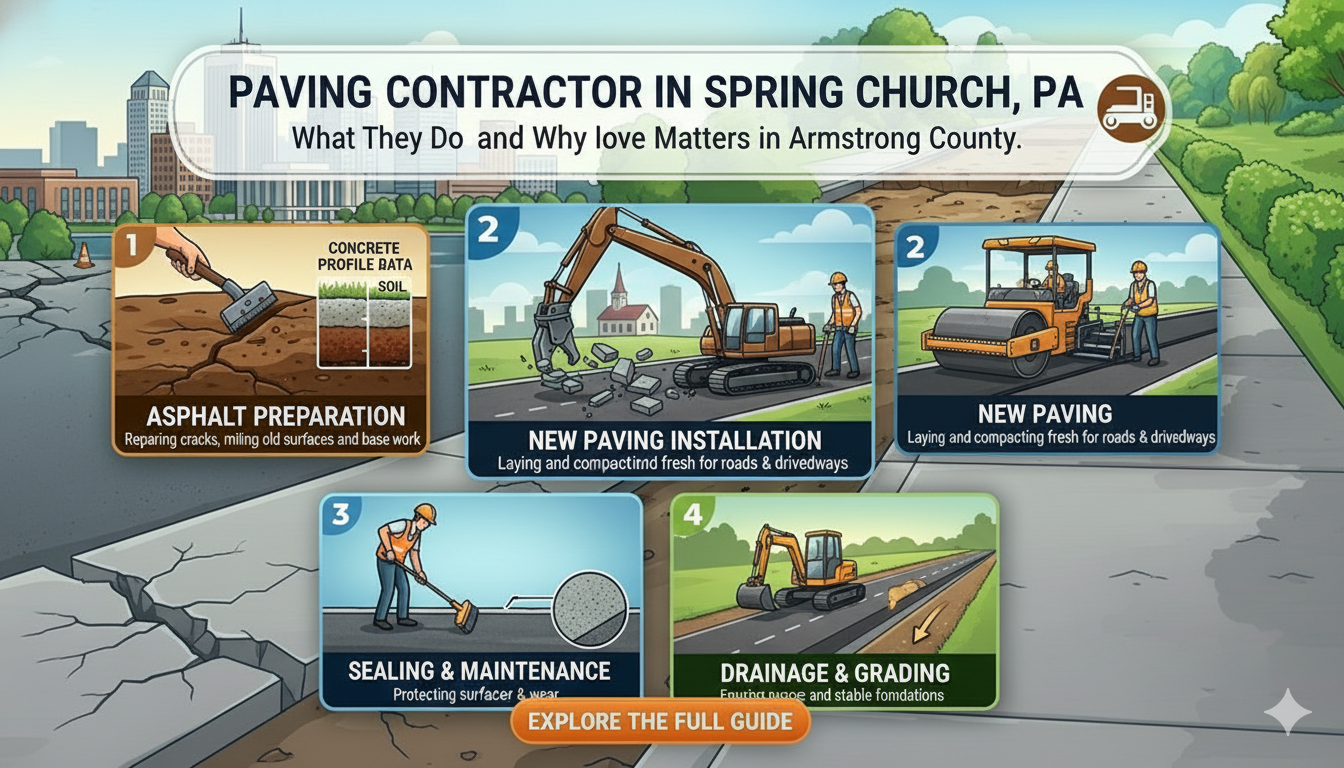
New Asphalt Installation The most comprehensive service a paving contractor provides, new installation begins with the soil beneath the surface and ends with a compacted, finished asphalt layer. The process includes subgrade evaluation and preparation, aggregate base installation and compaction, and asphalt lay-down in one or more lifts depending on the specified thickness. Every step matters: the quality of the finished surface depends entirely on the quality of what was done underneath it.
Asphalt Resurfacing (Overlay) When an existing asphalt surface has deteriorated but the underlying base is still structurally sound, resurfacing adds a new layer of asphalt over the existing surface. This extends the life of the pavement significantly without the cost and time of full reconstruction. The existing surface must be in an appropriate condition free from major cracking or base failure for an overlay to be a lasting solution.
Asphalt Milling Before resurfacing, or when a damaged surface needs to be removed before reconstruction, a milling machine grinds the existing asphalt to a controlled depth. Milling removes the old surface while preserving the base beneath it and creates a rough, textured profile that bonds well with the new asphalt layer placed on top. Milled material is collected and recycled back into new asphalt mixes.
Crack Sealing Cracks in asphalt surfaces allow water to infiltrate the base layers. In Armstrong County’s climate, that water freezes, expands, and widens the crack further with each freeze-thaw cycle. Crack sealing filling open cracks with a rubberised sealant is one of the most cost-effective maintenance activities available and significantly extends the time before more intensive repair or replacement becomes necessary.
Pothole Patching Potholes form when water-damaged base material collapses beneath the surface, creating a void that the overlying asphalt cannot bridge. Proper pothole repair requires removing the deteriorated material in the affected area and replacing it with compacted aggregate and new asphalt, rather than simply filling the surface depression with cold-mix patch. Quality pothole repair addresses the cause, not just the symptom.
Sealcoating A sealcoat is a protective layer applied to the surface of asphalt to shield it from the elements. UV radiation degrades asphalt’s bitumen binder over time, causing the surface to oxidise, become brittle, and grey. Water and petroleum products (fuel drips, oil stains) further accelerate surface degradation. Sealcoating provides a protective barrier against all of these, restoring the appearance of the surface and significantly slowing deterioration. Sealcoating is recommended every two to three years for well-maintained asphalt surfaces.
Line Striping Commercial parking areas, business lots, and institutional facilities require clear, properly marked lines: parking stalls, fire lanes, directional arrows, and ADA-accessible spaces. Line striping uses specialised thermoplastic or paint materials applied with striping machines to create durable, visible markings. In many settings, ADA compliance is a legal requirement, making accurate striping not just a courtesy but a necessity.
Concrete Work Many paving contractors also perform concrete work, including concrete driveways, aprons, curbs, walkways, and pads. Concrete and asphalt are complementary in many applications asphalt is typically preferred for large surface areas while concrete is used for curbs, decorative features, and high-load areas where its rigidity is an advantage.
Excavation and Site Preparation Before any paving project begins, the site must be graded, drained, and prepared. Paving contractors with excavation capabilities can manage the full sequence: clearing the site, establishing proper drainage grades, installing aggregate base, and then paving all under one contractor rather than coordinating between multiple firms.
Roadway and Private Road Paving In rural Armstrong County, private roads connecting farmsteads, residences, and rural properties are a significant part of the paving landscape. These roads face unique demands: heavy agricultural equipment, weather exposure, and the absence of public maintenance. A paving contractor familiar with rural road design understands the base thickness, drainage requirements, and material specifications needed for a private road to function reliably under these conditions.
The Armstrong County Environment: What Makes This Area Distinctive for Paving
Spring Church sits in the rolling topography of Armstrong County, where the Allegheny and Kiskiminetas Rivers have carved a landscape of ridges, valleys, and hollows that characterises much of Western Pennsylvania. This terrain beautiful but demanding creates paving challenges that differ substantially from those encountered in flatter regions.
Slopes and Grades Virtually every driveway, road, and paved area in Spring Church and the surrounding countryside deals with grade changes. Water management on sloped surfaces requires precise grading and drainage design to ensure runoff moves away from structures and does not collect in low points where it will accelerate pavement damage. A paving contractor unfamiliar with hillside conditions may grade incorrectly, leading to chronic drainage problems regardless of how well the surface material itself is installed.
Pennsylvania Winters Armstrong County experiences genuine winter weather. Temperatures regularly drop well below freezing for extended periods, and the freeze-thaw cycle repeated transitions across the freezing point is the primary force acting against asphalt surfaces throughout the colder months. Asphalt specified and installed for Pennsylvania’s climate is formulated differently from material used in milder regions. A local contractor knows this and selects materials appropriate to the conditions.
Clay-Rich Soils The soils of much of Western Pennsylvania, including the Spring Church area, contain significant clay. Clay behaves differently from sandy or gravelly soils in ways that matter enormously for paving: it expands when wet and contracts when dry, it is more difficult to compact uniformly, and it can become very soft when saturated, reducing the load-bearing capacity of the subgrade beneath a paved surface. Proper base preparation on clay soils may require deeper aggregate layers or the addition of geotextile fabric to provide a stable platform for the pavement above.
Rural Property Challenges Paving work in rural Armstrong County often involves properties that are more complex to access than suburban or urban sites. Long driveways, limited turnaround space, unpaved access roads, and proximity to agricultural features all shape how a paving project is planned and executed. A contractor experienced in rural Western Pennsylvania work understands these logistics and plans accordingly.
The Difference Between Good and Poor Paving Work
Many property owners cannot immediately distinguish quality paving from inferior work both may look similar immediately after completion. The difference reveals itself over time, often within the first few years. Understanding what separates a well-built paved surface from a poorly built one helps property owners in Spring Church ask the right questions and make informed decisions.
Base Preparation The most important element of any paving project is the least visible. A contractor who skimps on base thickness, skips proper compaction, or fails to address drainage before paving creates problems that will surface regardless of the quality of the asphalt laid on top. Proper base preparation takes time, adds cost, and is invisible in the finished product but it is the difference between a surface that lasts 20 years and one that fails in 5.
Compaction of the Finished Surface Asphalt must be compacted while it is still hot enough to be workable. The compaction window closes as the material cools, and in cooler temperatures or when projects are too large for the available crew, corners get cut. Properly compacted asphalt has a dense, void-free structure that resists water infiltration, traffic-induced deformation, and freeze-thaw damage. Under-compacted asphalt is soft, susceptible to rutting, and fails much sooner.
Edge Quality The edges of asphalt surfaces are their most vulnerable points. Properly finished and compacted edges resist crumbling through freeze-thaw cycling. Edges that were rushed, under-compacted, or left without proper support begin to break apart within a few seasons, creating a progressive deterioration that works inward from the perimeter.
Drainage Integration A well-built paved surface drains water efficiently and completely. There should be no low spots where water pools after rain. A contractor who ignores drainage in the design phase creates chronic problems that no amount of surface maintenance can correct.
Why Local Expertise Matters in Spring Church
Townsend & Skursky Paving LLC is based at 333 Townsend Road in Spring Church, Pennsylvania within Armstrong County, the same community the company serves. Founded in 1994, the company has spent over three decades building a reputation for quality work throughout Western Pennsylvania, including rural communities across Armstrong County, as well as in the broader Pittsburgh metropolitan area.
The advantage of a locally rooted paving contractor extends beyond familiarity with road names and property locations. It means understanding how the clay soils of Armstrong County behave in wet springs, knowing the specific freeze-thaw dynamics that Pennsylvania winters impose on pavement, and having built relationships in the community that create accountability on every project. A contractor who lives and works in the same area as their clients approaches every job knowing that their reputation is built job by job, neighbour by neighbour.
Townsend & Skursky’s services in Spring Church and the surrounding area cover the full range of paving needs: residential driveways, farm and rural access roads, commercial parking areas, sealcoating and maintenance programmes, pothole repair, and excavation for site preparation. Their crews handle projects from start to finish, meaning property owners work with one point of contact from site assessment through final compaction.
Understanding the Paving Season in Armstrong County
Pennsylvania’s climate defines when asphalt work can be done effectively. Asphalt must be laid and compacted at temperatures above 50 degrees Fahrenheit to bond and compact properly. In practice, the paving season in Armstrong County runs from late spring through early autumn roughly May through October, with the most productive months being June, July, August, and September.
This seasonal constraint has practical implications for project planning. Contractors are busiest during the summer months, and scheduling for the most popular project types residential driveways, in particular often means booking several weeks in advance during peak season. Property owners who notice their driveway needs attention in late autumn may need to plan for the following spring rather than expecting immediate availability.
Crack sealing and sealcoating can be performed in a somewhat wider window than new paving, as they do not require the same temperature conditions for material bonding. However, these services also cannot be performed effectively in cold or wet weather.
Conclusion
A paving contractor in Spring Church, Pennsylvania is a technical specialist whose work shapes the functionality and appearance of properties throughout Armstrong County. From the foundational base preparation that nobody sees to the finished surface that residents drive across every day, quality paving is built on knowledge of local conditions, appropriate materials, skilled execution, and a commitment to doing the work correctly rather than quickly. For property owners in Spring Church whether planning a new driveway, repairing a deteriorated surface, or maintaining an asphalt investment through regular sealcoating understanding what the trade involves is the foundation for choosing the right contractor and getting results that last.